
Dear colleagues,
We are delighted to take this opportunity to introduce our Emotional Availability (EA) trainers around the world:
- Finland: Saara Salo
- Japan: Young Ae Kang
- Türkiye: Gizem Arikan
- The Netherlands: Hedwig van Bakel
In addition, our network of trainers and EA hubs continues to grow globally, with further expansion planned.
Please join us in welcoming these trainers, who will be conducting inaugural and additional EA trainings this spring, offered in person and/or via interactive Zoom.
Self-paced and hybrid formats (pre-recorded content combined with live Zoom sessions) by Prof. Zeynep Biringen will also continue.
More information about these initiatives will be shared in 2026.
About the Emotional Availability (EA) Scales
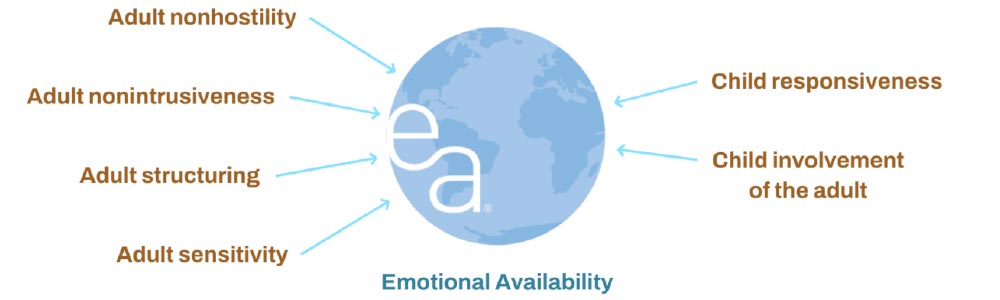
For those new to the observational Emotional Availability (EA) Scales, EA assesses the quality of the adult–child relationship as a relationship system, rather than focusing on individual adjustment.
The system includes:
- Four adult dimensions: sensitivity, structuring, nonintrusiveness, and nonhostility
- Two child dimensions: child responsiveness to the adult and child involvement of the adult
Each dimension is global in nature and captures the overall quality of the relationship across development.
In addition, the EA system includes EA Zones, which summarize the pattern of the relationship and provide a framework comparable to attachment styles. The four zones are:
- Emotionally Available
- Complicated
- Detached
- Problematic / Traumatized / Traumatizing
Within each zone, dimensions are rated from high to low. Zones and dimensional ratings are provided separately for the adult and the child, allowing for potentially different attachment perspectives.
A separate reliability test (7–10 independently scored cases) is required.
EA is an evidence-based system applicable to adult–child relationships from birth through age 17, and uniquely spans development from the prenatal period through late adolescence.
The EA Basic Training focuses on ages 0–5 years and serves as a foundation; once mastered, extending the system to older ages is relatively straightforward.
The system also includes EA Briefing, a structured method for providing feedback to parents.
Specialized Training and Research Base
Dr. Saara Salo leads the EA Prenatal Training, focusing on sensitivity and nonhostility. The Emotional Availability (EA) Basic Training 2026 course will be held on May 20th – 22nd via Zoom. You can find further details on the course here.
Currently, four major review articles summarize approximately 500 research studies using the EA system. A full list of publications is available on the website under the Research section. Soon, articles will also be organized by topic areas (e.g., attachment, preterm birth, child disabilities).
The EA system is now in its 4.1 edition and has been widely used in research and practice since 1993. Both researchers and practitioners benefit from learning and applying this integrative, attachment-based observational approach.
Links:
Emotional Availability – https://emotionalavailability.com/
Emotional Availability (EA) Basic Training 2026 – Link to course information